
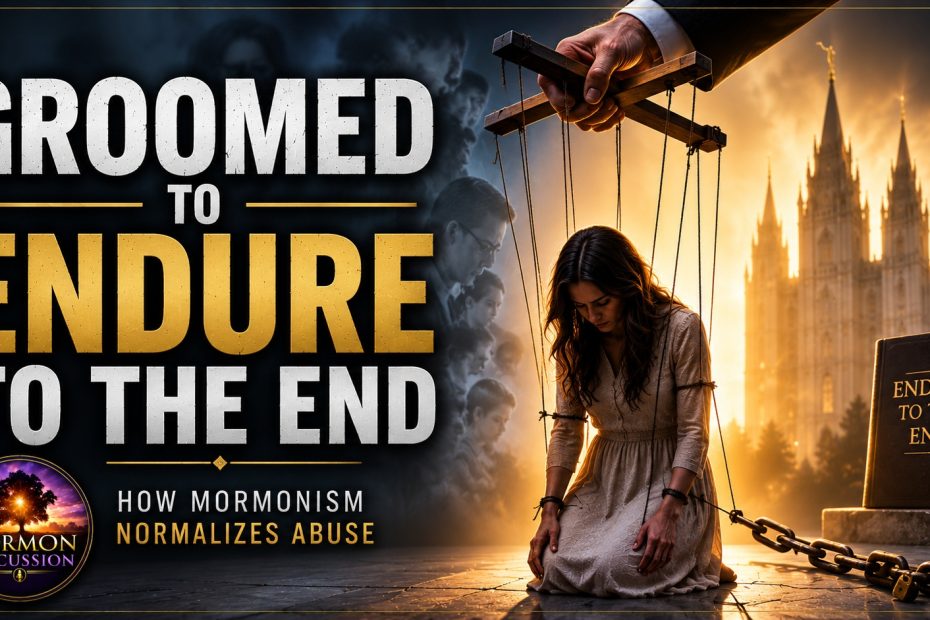
What happens when a religious system spends a lifetime teaching you to trust authority, obey, forgive, sacrifice, endure, distrust your own doubts, and fear the consequences of leaving? In this episode of Mormon Discussion, Teresa Hobbs leads Bill Reel and special guest Wendi Wilcock Jensen through a difficult question: Can LDS teachings and institutional structures unintentionally condition members with some of the same psychological habits that make coercive control and abusive relationships harder to recognize, resist, disclose, and escape? We trace these patterns across the Mormon lifespan—from Primary lessons about obedience and following the prophet, to teenage worthiness interviews and sexual shame; missionary obedience and surveillance; BYU’s institutional controls; temple marriage, gender hierarchy, forgiveness and divorce stigma; and finally the enormous social, familial and spiritual costs that can accompany dissent or leaving the Church. We also examine how these dynamics have affected women, LGBTQ and transgender members, racial and ethnic minorities, and others whose personal judgment or identity has sometimes collided with institutional authority. The argument is not that every Mormon experiences abuse or that every LDS teaching was deliberately designed to facilitate it. The question is what happens cumulatively when obedience, authority deference, confession, shame, hierarchy, self-sacrifice, institutional dependency and high exit costs become deeply embedded in a person’s understanding of righteousness. Because the disturbing possibility is this: the qualities someone has been taught make them faithful may sometimes be the very qualities an abusive person can exploit.
Wendi Wilcock Jensen Wendi Jensen is an author, speaker, and identity reconstruction coach who helps people rebuild a relationship with themselves after high-demand religion, toxic relationships, and other systems that taught them to distrust their own inner knowing. Her work bridges emotional healing, nervous-system awareness, and embodied self-reconnection, helping people move beyond simply understanding what happened to them and begin creating a life rooted in autonomy, authenticity, and self-trust by reconnecting with the body. She is also the author of The Healing Questions Guide- relevant questions to ask the mind to activate healing in the body. To reach Wendi – [email protected]
Teresa Hobbs Teresa Hobbs is a Certified Trauma Recovery Coach™, Pain Reprocessing Therapy practitioner, and Safe and Sound Protocol (SSP) provider and founder of Monarch Integrative Coaching. Her work integrates nervous-system regulation, Polyvagal Theory, attachment theory, mindfulness, somatic practices and mind-body approaches. She also works with people rebuilding self-trust and identity following high-demand religion. Coaching and Chronic Fatigue support https://www.monarchintegrativecoaching.com/
This conversation ultimately asks something larger than whether Mormonism explicitly condemns abuse. What does a lifetime of religious conditioning teach a person to do when authority conflicts with intuition, obedience conflicts with boundaries, forgiveness conflicts with accountability, and “enduring to the end” conflicts with getting yourself to safety? #MormonDiscussion #Mormonism #LDS #ExMormon #ReligiousTrauma #SpiritualAbuse #CoerciveControl #DomesticAbuse #ReligiousDeconstruction #Trauma #HighDemandReligion #MormonChurch

Podcast: Play in new window | Download
Subscribe: RSS